
Collier Research is now Collier Aerospace
Explore our new website at collieraerospace.com

HyperSizer is now HyperX

The Ultimate Stress Tool
HyperSizer Pro is software for the aerospace industry. From preliminary optimization for weight reduction and manufacturability to final design certification, the software uses the same analysis methods from beginning to end of the project – avoiding unexpected negative margins and weight growth. HyperSizer simultaneously analyzes and optimizes panel cross-section dimensions, materials, and stacking sequences for all load cases and failure modes. The analysis margins along with traceability details are exported to Word and Excel documents for certification reporting.
Work Flow
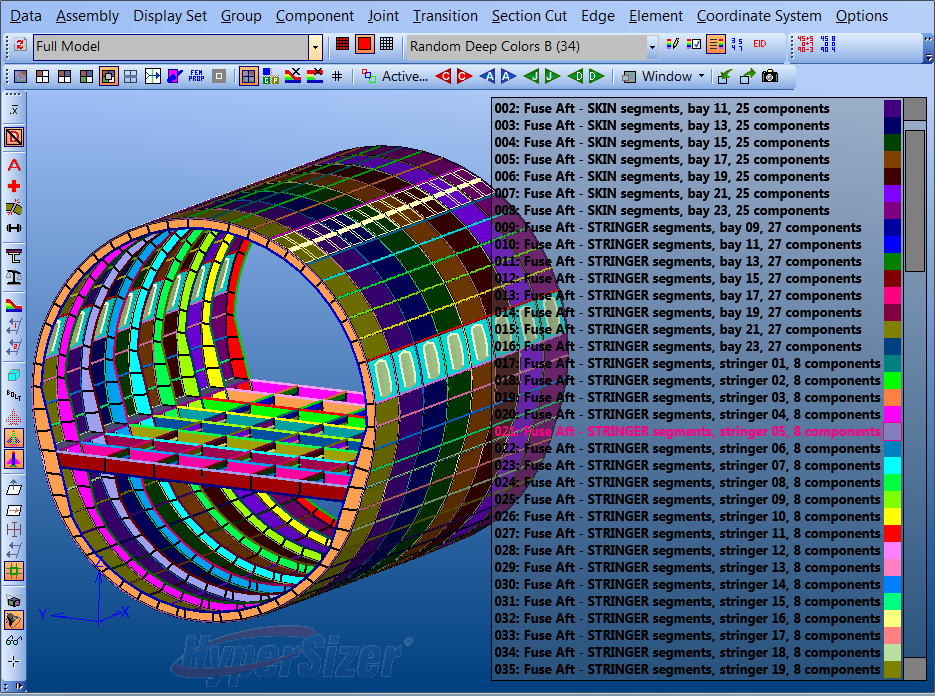
The global finite element model (GFEM) grids, elements, and properties are imported to define geometry. Shell, beam, and solid elements are translated into structural components such as panels and joints. With the FEM linkage defined, the computed loads are extracted from the resulting FEA output files. MSC Nastran, NX Nastran, Abaqus, and OptiStruct solvers are supported. Next, detailed stress analysis is performed for hundreds of load cases and for hundreds of failure analyses.
Stress Sizing
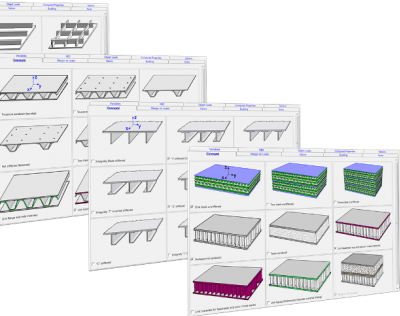
HyperSizer specializes in detailed stress sizing of over 50 different stiffened panel shapes and sandwich panels. Cross sectional geometry of stiffened panels are simultaneously optimized with the laminates’ ply stacking sequences or metal sheet thicknesses while considering manufacturing constraints.
Sizing is based on a broad and deep collection of failure analyses. By combining full-fidelity certification analysis (see customer analysis plugins) with sizing optimization it is common to see 20% weight reductions maintained throughout the design maturation process going from PDR to CDR to part production.
- Size skin thicknesses and stiffener dimensions
- Optimize laminate ply stacking sequences
- Sequence laminates for manufacturability by reducing ply drops/adds
Rapid Sizing
Non-parametric optimization does not require the user to input min and max values for sizing variables or to generate candidate laminates. This insanely fast approach is particularly well suited to FEMs that do not discretely model stringers, allowing the software to explore different panel concepts and stiffener spacings.
Detailed Sizing
Parametric optimization allows user control over min and max sizing variables. Usually performed pre PDR with smeared FEMs. Post PDR usually panel concept and stiffener spacing is decided and detailed sizing is then performed with discretely meshed stringers.
Both rapid and detailed sizing can optimize model stiffness distribution using nodal deflection and eigenvalue limits with Global FEA Constraints.
Stress Analysis
Whether the design is defined with HyperSizer sizing, or imported from spreadsheets of geometry, dimensions and laminates, HyperSizer Pro CAE software specializes in detailed stress analysis of stiffened panels, sandwich panels, bolted joints, and bonded joints using industry-standard methods and finite element modeling techniques.
- Ply-Based Strength – Max Strain, Tsai-Wu, Puck; with allowable correction factors
- Laminate-Based Strength – Compression after impact (CAI), Open Hole Compression (OHC), AML, %45
- Stiffened Panels – Crippling, Skin instability, Beam-Column, Flexural Torsional Buckling, Postbuckling, IDT
- Sandwich – Core Shear, Flat Wise Tension, Wrinkling, Intracell Dimpling
- Joints – Bonded, Bolted with bearing by pass, BJSFM
Get the analysis done faster! Process thousands of load cases! Resolve negative margins with automated sizing!
Read how HyperSizer was used to design and analyze this Bell V280 helicopter fuselage in 22 months >
Stress Certification
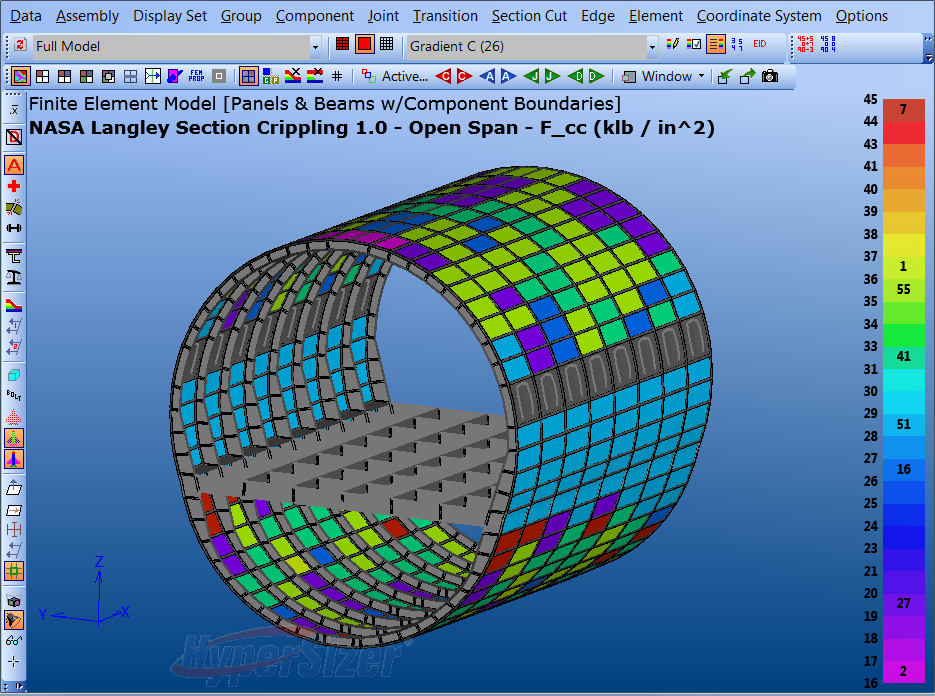
The final deliverable for stress analysts is the stress report. HyperSizer generates Word and Excel stress reports with an emphasis on full analysis traceability for FAA certification. Examples of such data include – sample calculations, margins of safety, critical load cases, analysis traceability details, material properties, and 2D maps (data in terms of stringer-bay coordinates).
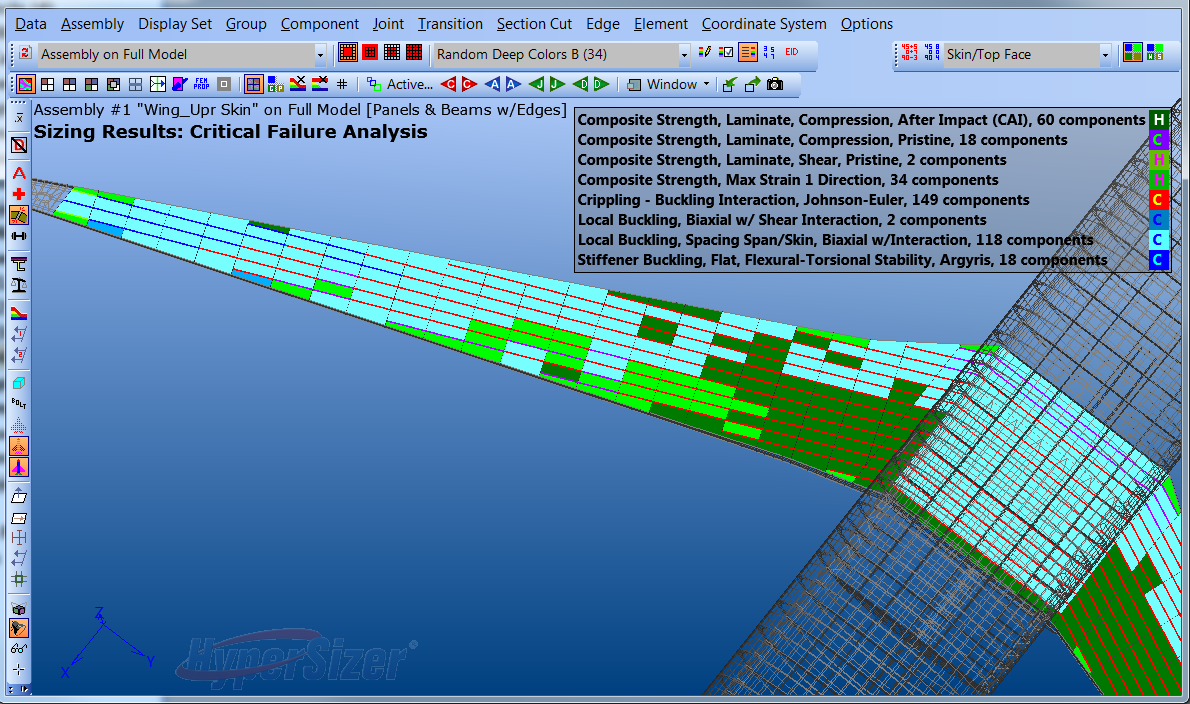
However, well before final analysis, the stress engineer is always in need of reporting the status of the project for management review. Additionally, to fully understand and substantiate the calculations, the stress engineer needs daily, a tool, that provides complete and easy traceability of all intermediate data that feeds into the critical margins – to able to identify peak controlling loads from the many thousands and to see all of the failure mode results. And then to be able to isolate any give failure analysis, and plot any given data related to it. HyperSizer’s detailed spreadsheets and FEM Viewer provides this visibility.
Stress Framework
Stress Framework is a term to describe an enterprise level in which Pro is implemented for an aircraft within one or many stress groups. All of the capabilities described below are licensed with HyperSizer Pro.
What is a stress framework?
It is a way to provide consistent analysis methods, material allowables, and work flow processes across an organization such as an OEM or Tier 1 and all of their suppliers.
• Standard and consistent use of approved analysis methods
• A corporate material database containing your company’s approved allowables
• FEA load extraction of thousands of load cases, and identifying critical load conditions
• Sizing metal and composite parts daily, with discretely meshed models
• GFEM updating and management of hundreds of files
• Data exchange with master parts dimensions spreadsheets including laminate ply schedules with CAD such as CATIA
How to deploy a stress framework?
1) Develop Analysis Plugins of company’s methods
2) Establish a process to use the material database consistently from FEM assignment to HyperSizer failure predictions
3) Deploy Work Packages of margin policies, user roles, and project setup
4) Setup aircraft specific GFEM Element Mapping to identify structural skin, stringer, frame segments to size structure and assign margins to parts – not to finite elements